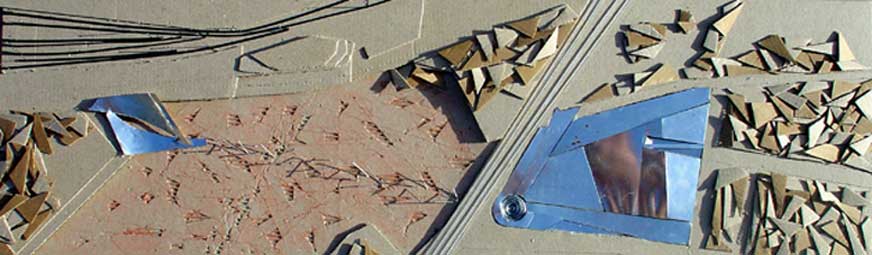
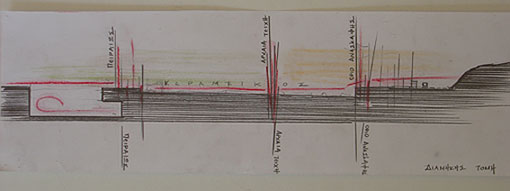
The primary intention of this design is to mark the axis of
Iera Odos and Iridanos River that traverse the archaeological
site of Keramikos. This axis is interrupted by three vertical
breaches formed by Pireos Avenue, the ancient Walls and the
5-meter difference of height between the city plane and the
ancient ruins at the point where the excavation came to a halt.
The ancient Walls divide the archaeological site in two conceptual
and spatial unities. Inside the city and its every day life
prevail. On the contrary, outside the walls lies the city of
the dead with its numerous tombs and headstones along the ancient
Iera Odos.
Two new entrances are proposed for the archaeological site.
They are situated on the axis in order to enable the movement
of visitors along it and to eliminate the contemporary vertical
breaches and emphasize on the ancient Walls.
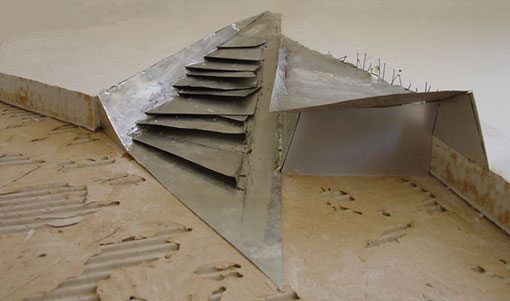
The one inside the ancient Walls is connected with the city,
its life and activities. The horizontal plane between the pedestrian
walkway of Ermou street and the archaeological site breaks into
two triangular segments. The two forms unfold their volumes
to create a public space that guides the circulation of visitors
inside the archaeological site. At the same time, it provides
two slopping spaces for resting and enjoying the view, the one
orientated towards the Acropolis.
A second entrance for the archaeological site is proposed, this
time outside the ancient walls and thus, with a different meaning.
Connected with the motion of death it aims to create a ritualistic
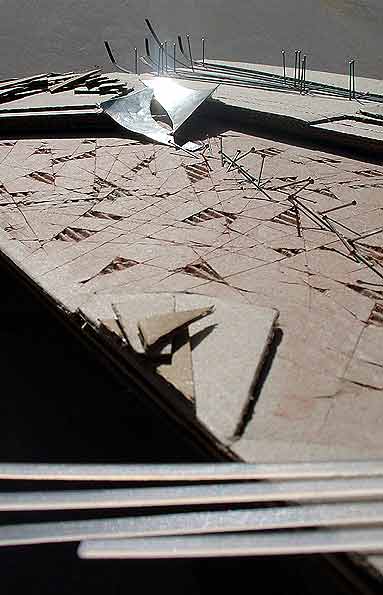
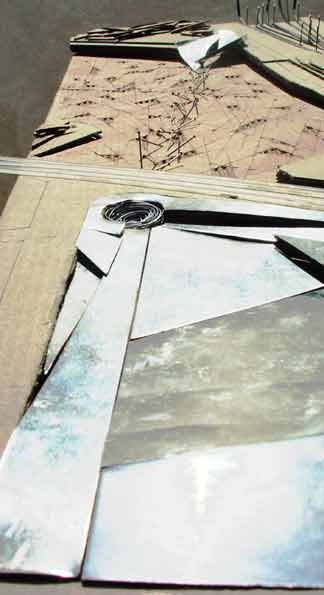
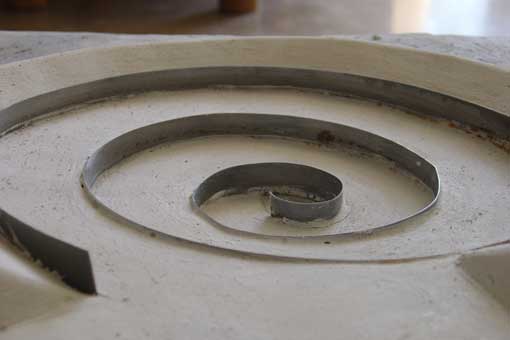
passageway beneath the level of Pireos Avenue. A public square
is designed in the block demarcated by Iera Odos, Pireos and
the cultural complex of Gazi. Its plane shatters into segments,
which incline to gradually lower the level of the square and
drain the flows of movement from the surrounding areas towards
the point where Pireos and Iera Odos meet. There through a spiral
movement the visitors cross under Pireos Avenue and enter the
archeological site.
|